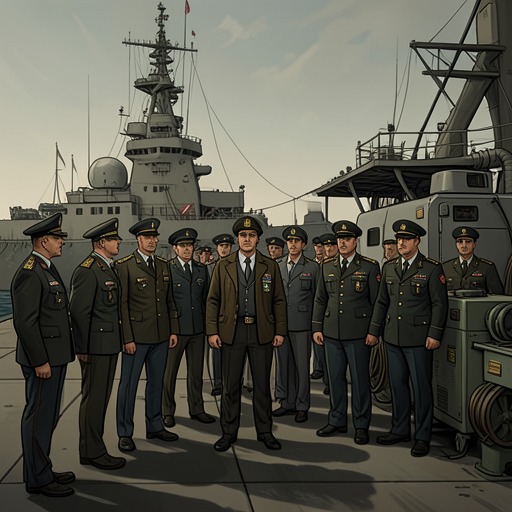
Announcement of Japan’s Surrender Aboard the Caine
The Caine Mutiny Court-MartialThe Announcement of Japan’s Surrender Aboard the Caine is the moment when the long-awaited end of the war reaches the ship by radio. For the crew it brings a sudden release into celebration; for Willie Keith, it confirms that he has come through the war alive even as he fears that the future he imagined in the Navy has closed.
Rumors and Waiting
The announcement comes after news of the atomic bomb and Russia’s declaration of war against Japan have already transformed the mood aboard the Caine. Officers and sailors begin speaking of marriage, education, and civilian careers, though some crewmen insist the reports are propaganda. The admirals’ daily warnings that the war continues do little to restrain the growing expectation of peace. Willie shares the crew’s hope of leaving the Navy, but keeps the ship’s routine moving while newer officers crowd around the wardroom radio and complain about the delay. The ship’s doctor, newly arrived in June, repeatedly argues that Japan surrendered a week earlier and that the government is concealing it to keep reservists in service.
The Broadcast
On the evening of August 10, Willie sits through part of a foolish movie on the forecastle, then goes below to read Bleak House on his bunk. When the jazz on the radio cuts off for an important bulletin, he rushes to the wardroom. The surrender announcement lasts only a couple of sentences; then the music resumes. The brevity of the broadcast contrasts with the months of uncertainty that have preceded it. Willie’s first response is overwhelming relief: he has survived the war. But when he looks out through a scuttle toward the moonlit harbor and Okinawa, relief gives way to a private sense of loss. He believes Tom Keefer will take the Caine to the boneyard and that he himself will never command a United States warship.
Celebration in the Harbor
A military band begins playing When Johnny Comes Marching Home. A single green star shell rises over Okinawa, followed by a vast display of colored tracers, searchlights, flares, and star shells. The illumination is not a planned peacetime spectacle but ammunition fired into the sky in celebration of peace. Sailors begin dancing and jumping on the deck overhead; ships across the harbor join in, their guns adding to the rolling noise over the water.
The Caine’s 20-millimeter guns rattle as they did during the kamikaze attack, shaking the bulkheads. Their sound carries the violence of the ship’s recent wartime service into the celebration, making the end of the war audible not as silence but as a final eruption of gunfire. The scene’s public jubilation and Willie’s private disappointment coexist: the war is over, but the end of danger does not guarantee the future he had hoped to earn.
Significance
The announcement reverses the crew’s uncertainty into certainty and turns routine shipboard space—the wardroom radio, forecastle, and decks—into the setting for a collective release. Yet the event does not simply resolve Willie’s wartime story. His relief at surviving is immediately complicated by the belief that the Caine will be discarded and his own naval ambition will end with it. The celebration therefore marks both a national ending and a personal disappointment, with the ship’s guns linking the two.